Issue 56, 2025, Issue in Progress

Density functional study of PuC and PuC0.75O0.25

Abstract

We study the structural, magnetic, electronic, thermodynamic and elastic properties of PuC and PuC0.75O0.25 using density-functional theory (DFT) and DFT + U. The nonmagnetic (NM), ferromagnetic (FM) and antiferromagnetic (AFM) configurations are considered in this work. Total energy results obtained with DFT + U indicate that PuC0.75O0.25 has an AFM ground state, matching the AFM nature of stoichiometric PuC. Calculated electronic properties reveal a new density of states peak in PuC0.75O0.25, a consequence of C/O substitution in PuC. Thermodynamically, PuC0.75O0.25 exhibits higher enthalpy difference (HTH298), entropy difference (STS298) and heat capacity (Cv and Cp) than PuC at the same temperature; elastically, it is predicted to be harder, owing to the stronger ionic character of Pu–O versus Pu–C bonds. Crucially, the formation energy of the oxygen-substitution defect is calculated to be highly spontaneous (−5.11 eV), revealing the fundamental driving force for the oxidation and chemical aging of PuC. These results are intended to provide a valuable reference for further theoretical and experimental investigations of PuC and PuC0.75O0.25.
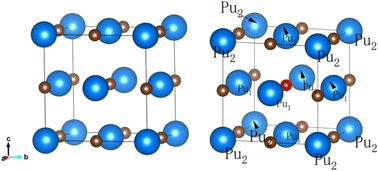
Graphical abstract: Density functional study of PuC and PuC0.75O0.25

Article information

Article type
Paper
Submitted
27 Aug 2025
Accepted
21 Nov 2025
First published
08 Dec 2025
This article is Open Access
Creative Commons BY-NC license

RSC Adv., 2025,15, 48296-48305

Density functional study of PuC and PuC0.75O0.25

R. Yang, Z. Zhang and B. Tang, RSC Adv., 2025, 15, 48296 DOI: 10.1039/D5RA06402C

This article is licensed under a Creative Commons Attribution-NonCommercial 3.0 Unported Licence. You can use material from this article in other publications, without requesting further permission from the RSC, provided that the correct acknowledgement is given and it is not used for commercial purposes.

To request permission to reproduce material from this article in a commercial publication, please go to the Copyright Clearance Center request page.

If you are an author contributing to an RSC publication, you do not need to request permission provided correct acknowledgement is given.

If you are the author of this article, you do not need to request permission to reproduce figures and diagrams provided correct acknowledgement is given. If you want to reproduce the whole article in a third-party commercial publication (excluding your thesis/dissertation for which permission is not required) please go to the Copyright Clearance Center request page.

Read more about how to correctly acknowledge RSC content.

Social activity

Spotlight

Advertisements