


 PLATFORM UPDATE:

Engineering surface hydrophobicity/hydrophilicity of magnetic nanosorbents for efficient multipollutant water remediation

Abstract
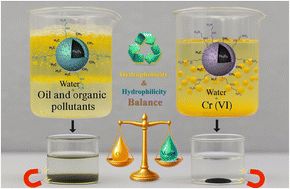
A series of magnetic sorbent materials were prepared via functionalization of magnetic nanoparticles using trimethoxymethylsilane (TMMS) and/or N-[3 (trimethoxysilyl)propyl]ethylenediamine (TMSPEDA) at varying molar ratios to precisely control surface hydrophobicity/hydrophilicity. The physic–chemical properties of the prepared materials were thoroughly elucidated by various techniques including Fourier-transform infrared spectroscopy (FT-IR), field emission scanning electron microscopy (FESEM), transmission electron microscopy (TEM), thermo-gravimetric analysis (TGA), vibrating-sample magnetometer (VSM), EDX and elemental mapping, wide-angle X-ray diffraction (XRD), N2 adsorption/desorption analysis, and contact angle measurement, confirming successful modification and tailored surface properties. When evaluated for multipollutant water remediation, the optimized Mag@N1M3 exhibited superior performance in removing oils and organic pollutants due to its balanced hydrophobic/hydrophilic nature. Meanwhile, Mag@N1M1 showed exceptional efficiency in adsorbing trace Cr(VI) ions, attributed to its additional amine coordination sites. Thanks to their strong magnetic response, all sorbents were rapidly separated using an external magnet and reused for five cycles without significant efficiency loss, demonstrating excellent recyclability and potential for scalable water treatment applications.
 Please wait while we load your content...


