


 PLATFORM UPDATE:


Spectroscopic investigation of cation effects in U(vi)-NO3− complexation in aqueous solutions

Abstract
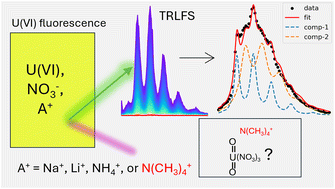
Understanding and manipulating uranyl speciation in aqueous solutions is critical for advancing chemical separation, sensing, and understanding environmental transport of uranyl. We report on the significant enhancement in the complexation of uranyl with nitrate in aqueous solutions containing quaternary ammonium cations leading to the formation of anionic complexes. We base this on the comparative study of the effect of monovalent cations (Na+, Li+, NH4+, and N(CH3)4+) on the complexation equilibria of uranyl-nitrate in solutions, probed by time-resolved laser induced fluorescence spectroscopy (TRLFS). Lifetime-corrected spectra, obtained by extrapolating the time-resolved spectra to t = 0, were used to study speciation to mitigate the effects of variations in the fluorescence lifetimes that depend on extraneous factors such as dynamic quenching. We demonstrate that the lifetime-corrected spectra can be used to determine uranyl speciation in aqueous solutions where the mono-nitrate complex forms, and in acetonitrile with N(CH3)4NO3 where di-nitrate and tris-nitrato species are formed. Aqueous solutions containing N(CH3)4+ are shown to promote the formation of higher complexes of uranyl compared to other inorganic nitrate salts based on the higher redshift in the spectra, poor fits to the two-component model, and the higher apparent formation constants. Comparing the trends in uranyl speciation in the presence of N(CH3)4+ in aqueous and acetonitrile solutions, it is proposed that the quaternary ammonium cations (quats) promote the formation of anionic complexes of uranyl by the ion-association mechanism. These results provide a basis for designing quat-assisted separation systems that target anionic actinide species in aqueous solutions.
 Please wait while we load your content...


