


 PLATFORM UPDATE:


Synergistic metal–carbon interactions in Fe3O4/N-MWCNT composites for electro-Fenton processes

Abstract
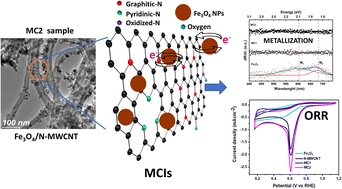
This work investigates the performance of graphitic nitrogen-doped multi-walled carbon nanotubes (N-MWCNT) decorated with Fe3O4 nanoparticles for the oxygen reduction reaction (ORR) and their application in the degradation of methyl orange (MO) using a heterogeneous electro-Fenton process. The combination of Fe3O4 and N-MWCNT enhances electrocatalytic activity through electronic metal-carbon interactions (EMCI), which promote charge transfer and improve electron mobility. Advanced characterization techniques, including TGA, TEM, XRD, Raman, XPS, UV-Vis, and electrochemical analysis, confirm the synergistic effects of combining graphitic N-MWCNT and Fe3O4 during a coprecipitation synthesis. DPR analysis reveals that the Fe3O4/N-MWCNT composites (MC1 and MC2) undergo a transition from semiconducting to metalloid behavior (thertherezation), supporting the improved electron transfer properties. Raman and XPS analyses further confirm the structural and electronic contributions of graphitic nitrogen in N-MWCNT and Fe3O4, reinforcing the composite's enhanced ORR efficiency. TEM and XRD analysis corroborated the anchorage of Fe3O4 in the composite, with crystallite particle sizes of 14.7 nm in MC1 and 16.8 nm in MC2. Electrochemical studies indicate that MC1 exhibits the highest electrochemically active surface area (25.1 cm2 mgFe3O4−1), mass activity (73.66 mA mgFe3O4−1), and turnover frequency (0.1768 s−1), indicating an increased number of active sites. Additionally, when composites are used as cathodic materials deposited by electrophoretic deposition (EPD), they effectively degrade 20 ppm of methyl orange at a neutral pH and a current density of 10 mA cm−2. MC1 achieved the highest degradation efficiency of 97.0% after 120 minutes in an electrode area of 12 cm2. This study provides new insights into how metal–carbon interactions at the nanoscale can be leveraged to engineer multifunctional catalysts for next-generation electrochemical systems.
 Please wait while we load your content...


