


 PLATFORM UPDATE:


First-principles investigation of structural, electronic, optical, mechanical, and phonon properties of Pb- and Sn-based cubic oxide perovskites for optoelectronic applications

Abstract
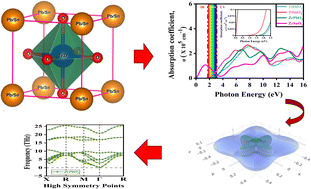
This study presents a comprehensive first-principles investigation of Pb- and Sn-based cubic perovskites (TiPbO3, TiSnO3, ZrPbO3, and ZrSnO3) using DFT within GGA-PBE and mGGA-rSCAN frameworks. Structural analysis confirms thermodynamic and structural stability for all compounds, with ZrPbO3 showing the lowest formation energy. Electronic band structure results reveal semiconducting behavior for TiPbO3 (1.996 eV), TiSnO3 (1.133 eV), and ZrPbO3 (2.349 eV), making them suitable for visible-light photovoltaics and photodetectors. In contrast, ZrSnO3, due to its metallic behavior, could be useful as a conductive layer or as an electrode in optoelectronic devices. Optical analysis highlights strong absorption in the visible region for TiSnO3 and ZrPbO3, while ZrSnO3 shows exceptional UV absorption (6.5 × 105 cm−1), suitable for UV shielding and plasmonic devices. High dielectric constants and low reflectivity further support optoelectronic and coating applications. Mechanical properties show TiSnO3 and ZrPbO3 possess high stiffness and ductility, ideal for flexible devices, while TiPbO3's anisotropy suits directional applications such as piezoelectric. ZrSnO3 is mechanically and dynamically unstable, limiting its immediate applicability. Anisotropy and phonon analyses confirm TiPbO3 and ZrPbO3 as mechanically and dynamically robust materials. Overall, TiSnO3, TiPbO3, and ZrPbO3 emerge as promising multifunctional candidates for optoelectronic, energy, and stress-sensitive applications.
 Please wait while we load your content...


