


 PLATFORM UPDATE:


Sludge biochar-enabled trace voltammetric detection of 2,2′,4,4′-tetrabromodiphenyl ether in water samples
 †*a
Yaoning
Chen,
*b
†*a
Yaoning
Chen,
*b
Abstract
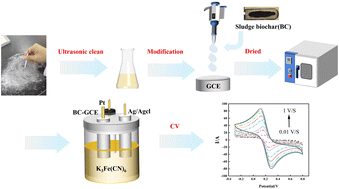
In this study, the conversion of municipal sludge into functional biochar modifiers enabled the construction of an ultrasensitive electrochemical interface for the quantification of trace-level 2,2′,4,4′-tetrabromodiphenyl ether (BDE-47), obviating the necessity for sample pretreatment. A novel electrochemical electrode was developed by modifying a glassy carbon electrode (GCE) with sludge biochar, and a linear equation was established for the determination of trace BDE-47 using cyclic voltammetry. Scanning electron microscopy (SEM), Brunauer–Emmett–Teller (BET) and Fourier transform infrared (FTIR) spectroscopy analyses revealed that the sludge biochar pyrolyzed at 600 °C in an oxygen-free environment formed additional pore structures with more adsorption sites. This enhanced the accuracy of the determination and improved the convenience of electrochemical detection. Additionally, factors such as the pH and scanning rate were optimized and examined. Under the optimized experimental conditions, the peak current increased linearly with the BDE-47 concentration in the range of 0.005 μg L−1 to 0.6 μg L−1, leading to the construction of a linear curve for the assay. The detection limit was 5 ng L−1, and the average recoveries ranged from 96.79% to 106.63%. Furthermore, this method was successfully applied to determine BDE-47 concentrations in real water samples, and the results were consistent with those obtained by liquid chromatography. The modified electrode established a simple yet robust voltammetric strategy for rapid BDE-47 screening in water, fulfilling the growing demand for decentralized monitoring tools for persistent organic pollutants (POPs).
 Please wait while we load your content...


