


 PLATFORM UPDATE:


Fluorescence-based dual detection of chlortetracycline and Pb2+ using nitrogen/phosphorus co-doped carbon quantum dots

Abstract
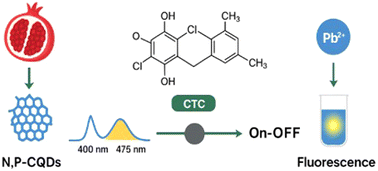
A dual-mode fluorescence sensor composed of nitrogen/phosphorus co-doped carbon quantum dots (N/P-CQDs) was synthesized to detect chlortetracycline (CTC) and Pb2+ ions sequentially and selectively. The N/P-CQDs were synthesized through a green hydrothermal process using pomegranate peel juice as a renewable carbon source. The resulting N/P-CQDs exhibit blue emission with excitation and emission peaks at 400 and 475 nm, respectively, and a mean size of 7.5 nm. Chlortetracycline (CTC) quenches the fluorescence of N/P-CQDs via the inner filter effect (IFE), and then, it is recovered in the presence of Pb2+ ions, which proves the reversible on–off–on sensing mechanism of this sensor. The emission intensity exhibited a linear response to CTC (0–100 μM and LOD of 30 nM), while Pb2+ (5–100 μM) successfully restored the signal with an LOD of 18 μM. Furthermore, this sensor has excellent selectivity, stability and reproducibility at the optimized pH, ionic strength, and temperature. Its recovery values were about 92–98% in the real sample analysis of tomato, milk and river water, indicating that the N/P-CQD probe is applicable in the area of environmental and food safety monitoring.
 Please wait while we load your content...


