


 PLATFORM UPDATE:


MgAl and ZnAl layered double hydroxides as efficient sorbents for phosphorus recovery from water
 *abc
Cláudia M.
Rocha,
b
Frederico
Maia,
b
Carlos M.
Silva
ac
and
Margarida J.
Quina
*a
*abc
Cláudia M.
Rocha,
b
Frederico
Maia,
b
Carlos M.
Silva
ac
and
Margarida J.
Quina
*a
Abstract
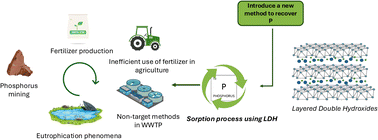
The global scarcity of phosphorus and increasing concern over aquatic eutrophication are driving greater interest in phosphorus (P) recovery from water. Emerging materials, such as Layered Double Hydroxides (LDH) or their calcined forms, Layered Double Oxides (LDO), are gaining attention for their excellent sorption capacity. This study aims to evaluate the performance of three different materials, a calcined MgAl-LDO, ZnAlNO3, and its calcined product ZnAl-LDO for phosphate removal in batch conditions. The foremost strength of this article is that the materials under studied are manufactured on a large scale, thereby facilitating the scaling up for practical applications. The materials were characterized by X-ray diffraction (XRD) and Fourier transform infrared (FTIR) before and after sorption. After calcination, MgAl-LDO reacquires its initial structure when in contact with an aqueous solution due to the “memory effect”, whereas ZnAl-LDO maintains its metal oxide state. Phosphorus removal by both calcined and non-calcined materials followed a pseudo-second-order kinetics. The ZnAlNO3 revealed a higher removal capacity when compared to ZnAl-LDO, which indicates that, in this case, the calcination does not improve its sorption capacity. The equilibrium study using ZnAlNO3 demonstrated that the Langmuir isotherm provided the best fit for the experimental data, with a maximum phosphorus loading capacity of 84 mg g−1. Overall, ZnAlNO3 appears to be a promising sorbent for the efficient and cost-effective removal of phosphate ions from eutrophicated water streams.
 Please wait while we load your content...


