


 PLATFORM UPDATE:


Electrochemical behavior and biocompatibility of TiO2@C core–shell NWs deposited by PECVD for cellular interface application
 *a
Shofarul
Wustoni,
c
Camelia
Florica,
b
Andrea
Diaz-Gaxiola,
d
Yaping
Zhang,
b
Youyou
Yuan,
b
Mohammed Nejib
Hedhili,
b
Sridhar
Govindarajan,
e
Imed
Eddine-Gallouzi,
d
Sahika
Inal
c
and
Hala
Aljawhari
a
*a
Shofarul
Wustoni,
c
Camelia
Florica,
b
Andrea
Diaz-Gaxiola,
d
Yaping
Zhang,
b
Youyou
Yuan,
b
Mohammed Nejib
Hedhili,
b
Sridhar
Govindarajan,
e
Imed
Eddine-Gallouzi,
d
Sahika
Inal
c
and
Hala
Aljawhari
a
Abstract
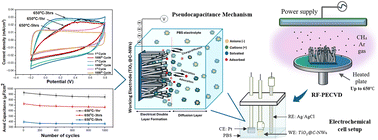
The selection of materials for neural interface electrodes relies heavily on two key criteria: electrochemical performance and biocompatibility. Carbon-based nanomaterials have attracted significant attention in neural interface research due to their excellent electrical conductivity, biocompatibility, and mechanical stability. However, achieving desirable electrochemical properties typically requires high-temperature synthesis (>1000 °C), which limits their integration with temperature-sensitive substrates and restricts broader device compatibility. In this study, we investigate TiO2@C core–shell nanowires (NWs) synthesized at a low temperature of 320 °C via plasma-enhanced chemical vapor deposition (PECVD), followed by in situ annealing at 450 °C, 550 °C, and 650 °C for durations of 1, 3, and 5 hours. We systematically evaluated their charge storage capacity, electrochemical impedance, long-term cycling stability, and in vitro biocompatibility. The 5 nm carbon shell, in situ annealed at 650 °C for 3 hours, demonstrated the highest areal capacitance of 874.4 μF cm−2 at 50 mV s−1 and a low impedance of 2.1 kΩ at 1 kHz, with 92% capacitance retention after 1000 cyclic voltammetry (CV) cycles. In addition, the electrode maintained stable performance across a range of scan rates, indicating resilience under dynamic stimulation conditions. Initial cell culture assays using HeLa cells confirmed the coating's cytocompatibility, supporting viable and non-cytotoxic cellular activity comparable to conventional substrates. These results highlight the potential of moderate-temperature synthesized TiO2@C core–shell nanowires as high-performance, biocompatible electrode materials with improved compatibility for integration into diverse neural interface platforms.
 Please wait while we load your content...


