


 PLATFORM UPDATE:


Computational modeling and photovoltaic performance evaluation of various ETL/HTL engineered CsCdI3-based perovskite solar cell architectures

Abstract
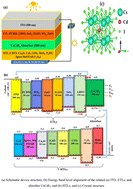
Perovskite solar cells (PSCs) have attracted significant attention in the field of photovoltaic technology owing to their exceptional properties. Despite their high efficiency, the commercial viability of lead-based PSCs is hampered by toxicity. All-inorganic PSCs, particularly those using CsCdI3 (Cesium Cadmium Triiodide), are promising alternatives. In this study, CsCdI3-based PSCs were investigated by optimizing various device components. We first investigated nine different back metal contacts (BMCs), and Ni (Nickel) was chosen as the BMC. Following BMC optimization, we assessed the effect of different electron transport layers (ETLs) and hole transport layers (HTLs). Eight distinct HTLs were combined with six ETLs to create unique structures. These configurations were optimized using SCAPS-1D simulation software, with successive enhancements to the thickness and defect density of the absorber and ETL thickness. The optimized structure (ITO/ZnO/CsCdI3/MoS2/Ni) achieved exceptional performance: 25.06% power conversion efficiency (PCE), 0.936 V open-circuit voltage (VOC), 30.7 mA cm−2 short-circuit current density (JSC), and 87.14% fill factor (FF). Furthermore, the dependence on several factors such as (Rs), (Rsh), and temperature changes, recombination, generation rates, band alignment (VBO/CBO), J–V characteristics, quantum efficiency (QE), capacitance, and Mott–Schottky (MS) analysis was explored for the six most promising devices. By using tolerance factor analysis, which includes Goldschmidt's and a newly proposed parameter, the structural stability of CsCdI3 is verified. This research represents significant progress toward an efficient, lead-free, and cost-effective solar cell technology.
 Please wait while we load your content...


