


 PLATFORM UPDATE:


Sustainable treatment and resource recovery from PCB acidic etching waste solution: Co-production technology of basic copper carbonate and copper oxide and transformation mechanisms
 *a
Shuxin
Liu
a
and
*a
Shuxin
Liu
a
and
Abstract
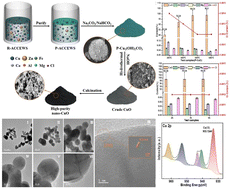
This study tackled the persistent challenges of low purity and limited diversity in recycled materials obtained from printed circuit board (PCB) acidic copper chloride etching waste solution (ACCEWS). High-purity Cu2(OH)2CO3 was first synthesized from purified ACCEWS (in contrast to raw waste solutions) using a Na2CO3–NaHCO3 buffer system. Subsequent alkaline treatment yielded crude CuO, which was then upgraded to high-purity CuO via calcination. Simultaneously, the effects of impurities on the purity, phase composition, and morphology of copper compounds were systematically investigated by XRD, SEM, TG, FTIR, ICP-OES, XPS and HRTEM, along with their transformation mechanisms and impurity behavior. The results demonstrated that purification markedly improved the purity of Cu2(OH)2CO3. Compared to untreated samples, the P-Cu2(OH)2CO3 derived from purified etching waste exhibited enhanced stability in copper content (55.40–55.50 wt% vs. 54.40–55.40 wt% in R-Cu2(OH)2CO3), reduced metal impurities (0.17–0.22 wt%), and notably lower chloride residues (consistently ≤0.014 wt%). Furthermore, purification effectively removed competitive interference from Cl− and other species during Cu2(OH)2CO3 crystallization, yielding more uniform particles with either flower-like spherical or spiky flake morphologies. The combined purification and calcination process significantly improved both the purity and crystallization behavior of nano-CuO. The nano P-CuO showed progressively increasing CuO purity: 80.24 wt% (300 °C/1 h), 92.24 wt% (400 °C/1 h), 98.54 wt% (500 °C/1 h), and 98.80 wt% (600 °C/1 h) – consistently higher than that of the corresponding R-CuO samples derived from untreated waste (68.48 wt%, 82.24 wt%, 94.48 wt%, and 97.90 wt%). Final optimization at 600 °C for 3 hours yielded ultra-pure P-CuO nanoparticles (≈110 nm) containing 99.04 wt% CuO with exceptionally low impurity levels: <0.12 wt% metallic impurities and <0.0015 wt% chloride content. This study demonstrated a “waste-to-wealth” approach through the simultaneous production of high-purity Cu2(OH)2CO3 and nano-CuO from the purification of ACCEWS. These findings offer important insights for both the sustainable utilization of PCB ACCEWS and the development of high-purity copper-based materials.
 Please wait while we load your content...


