Issue 37, 2025

A highly sensitive label-free aptamer sensor for timely detection of human serum albumin

Abstract

The trace-level detection of proteins in the human body holds significant importance for health monitoring and disease prevention. To conduct real-time monitoring of the human body's health status, both wearable and implantable devices require label-free sensing. However, the signals of a considerable number of label-free electrochemical sensors originate from the signal capture medium. These signals are weak and are prone to being lost or masked by other signals. We report a Prussian blue (PB)-based self-redox aptamer sensor was developed, enabling real-time human serum albumin (HSA) detection without external redox mediators. The designed sensing interface successfully achieved the quantitative detection of HSA in PBS with a sensitivity of 124 fg mL−1. In addition, to validate universality, the sensor was tested with retinol-binding protein (RBP4), showing comparable performance. This label-free electrochemical sensor can achieve one-step detection without additional reagents. This system has application potential in on-site detection, as well as wearable sensing.
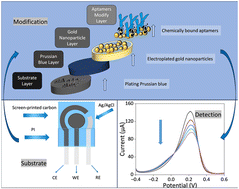
Graphical abstract: A highly sensitive label-free aptamer sensor for timely detection of human serum albumin

Article information

Article type
Paper
Submitted
21 Jul 2025
Accepted
21 Aug 2025
First published
02 Sep 2025
This article is Open Access
Creative Commons BY-NC license

RSC Adv., 2025,15, 30969-30979

A highly sensitive label-free aptamer sensor for timely detection of human serum albumin

H. Cheng, W. Chen, Z. Deng, M. Yin, C. Zhuang, Z. Qi, N. Xue and C. Liu, RSC Adv., 2025, 15, 30969 DOI: 10.1039/D5RA05254H

This article is licensed under a Creative Commons Attribution-NonCommercial 3.0 Unported Licence. You can use material from this article in other publications, without requesting further permission from the RSC, provided that the correct acknowledgement is given and it is not used for commercial purposes.

To request permission to reproduce material from this article in a commercial publication, please go to the Copyright Clearance Center request page.

If you are an author contributing to an RSC publication, you do not need to request permission provided correct acknowledgement is given.

If you are the author of this article, you do not need to request permission to reproduce figures and diagrams provided correct acknowledgement is given. If you want to reproduce the whole article in a third-party commercial publication (excluding your thesis/dissertation for which permission is not required) please go to the Copyright Clearance Center request page.

Read more about how to correctly acknowledge RSC content.

Social activity

Spotlight

Advertisements