


 PLATFORM UPDATE:


Enhanced elimination of Cr(vi) by sulphidated nanoscale zero valent iron biochar composites: performance and mechanism
 *a
*a
Abstract
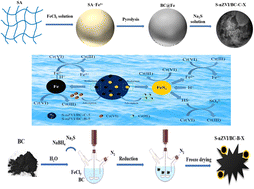
Nanoscale zero-valent iron–biochar (BC@Fe) composites were synthesised via a one-step carbothermal method, followed by sulphidation to obtain sulphided BC@Fe (S-nZVI/BC-C-X) composites. Sulphidated nanoscale zero-valent iron–biochar (S-nZVI/BC-B-X) was also prepared using a one-step sodium borohydride reduction method. Batch experiments were conducted to investigate the effects of adsorption time, initial Cr(VI) concentration, pH and background ions on the Cr(VI) removal performance of S-nZVI/BC-C-X and S-nZVI/BC-B-X. A comparative analysis of their adsorption characteristics and removal efficiencies was conducted. The adsorption mechanisms were further elucidated through kinetic and isotherm model fitting, masking experiments and characterisation of the composites before and after Cr(VI) adsorption. The findings revealed that Cr(VI) removal by S-nZVI/BC-C-5 primarily occurred via (i) reduction of Cr(VI) to Cr(III) by FeS, FeS2 and Fe0, (ii) reduction of Cr(VI) to Cr(III) by Fe2+, (iii) reduction of Cr(VI) to Cr(III) by HS− released from FeS corrosion and (iv) adsorption of Cr(VI) by S-nZVI/BC-C-5.
 Please wait while we load your content...


