


 PLATFORM UPDATE:


A dual-fluorescence approach for turn-on ammonia and turn-off explosive picric acid detection via ESIPT inhibition: experimental, theoretical, and biological studies

Abstract
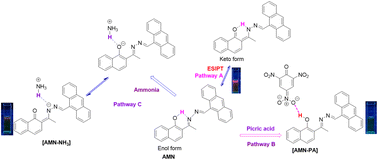
A fluorescent naphthalene–anthracene dyad (AMN) was developed as a dual-mode sensor for turn-on detection of ammonia (NH3) and turn-off detection of picric acid (PA). AMN initially emits strong fluorescence at 427 nm due to excited-state intramolecular proton transfer (ESIPT), showing a large 62 nm Stokes shift. Upon PA addition, fluorescence is quenched and red-shifted to 463 nm. Conversely, NH3 induces a red shift to 435 nm. These spectral responses are attributed to ESIPT inhibition via strong hydrogen bonding between the hydroxyl group of AMN and the analytes. AMN has been successfully applied in dipstick-based PA detection and as a low-cost food spoilage indicator for NH3. Detection limits are 8.77 μM for PA and 5.29 μM for NH3, with a Stern–Volmer constant of 5.62 × 10⁵ M−1 for picric acid. Additionally, AMN shows ratiometric fluorescence upon interaction with BSA and ct DNA, accompanied by notable absorption changes. These findings, supported by UV-vis, fluorescence spectroscopy, NMR, molecular docking, and DFT studies, underscore the potential of AMN as a multifunctional fluorescent sensor for environmental and biological applications.
 Please wait while we load your content...


