


 PLATFORM UPDATE:


Capillary-based pH-responsive nano-enzymatic SERS sensors for the diagnosis of Helicobacter pylori

Abstract
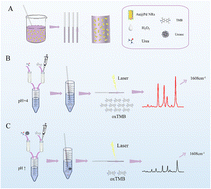
The accurate and sensitive detection of urease in saliva is the key to detecting Helicobacter pylori (H. pylori) infection. In this study, we developed a pH-responsive nano-enzymatic surface-enhanced Raman scattering (SERS) sensor for the indirect detection of urease concentration, with assembled nano-enzymatic gold core-palladium shell nanorods (Au@Pd NRs) on the inner wall of the capillary. The nano-enzymatic nanorods could catalyze the oxidation of 3,3′,5,5′-tetramethylbenzidine (TMB) by hydrogen peroxide (H2O2) to produce oxidized TMB (ox-TMB) with a strong SERS signal. When urease is present in the liquid taken up by the capillary, it specifically hydrolyzes urea, which increases the pH of the solution, inhibits the catalytic activity of the nano-enzyme and reduces the production of ox-TMB, leading to a decrease in the SERS signal and thus enabling the indirect detection of the concentration of urease. The sensor demonstrates excellent analytical performance with a low limit of detection (LOD) of 6.09 U L−1, and the detection process could be completed within 15 min. For real saliva samples, the results showed significant correlation with the urease test kit, enabling rapid and accurate detection of urease concentration in saliva samples from healthy individuals and H. pylori patients. Receiver operating characteristic (ROC) curves were used to evaluate the diagnostic efficacy of the sensor for detecting H. pylori, and the analysis showed that the area under the ROC curve (AUC) was 0.959, which is promising for application in clinical diagnosis.
 Please wait while we load your content...


