Issue 42, 2025, Issue in Progress

Continuous microwave tunnel expansion of vermiculite: a comparative study with thermal/chemical methods for structure-intact performance enhancement

Abstract

Vermiculite (VMT) expansion technology requires innovation to overcome its low efficiency and limited mechanical properties. Therefore, herein, a tunnel-type continuous microwave method was employed to optimize the VMT expansion process and enhance the performance and industrial value of the expanded VMT (EVMT). The microwave-expanded VMT (M-EVMT) exhibited minimal damage to the raw VMT structure compared with the thermal/chemical expansion methods, and at a 12 kW microwave power and 0.3 m min−1 conveyor belt speed, the raw VMT with 2.8–8 mm particle size could achieve larger interlayer microwave expansion and maintain its intact structure. Meanwhile, M-EVMT demonstrated unprecedented mechanical flexibility while maintaining a complete layered structure. This microwave method integrated mineral processing with circular economy, enhancing the energy efficiency, material performance, and industrial scalability of sustainable building materials.
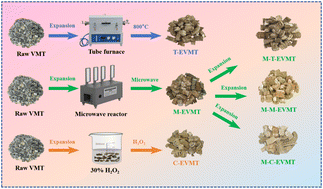
Graphical abstract: Continuous microwave tunnel expansion of vermiculite: a comparative study with thermal/chemical methods for structure-intact performance enhancement

Supplementary files

Article information

Article type
Paper
Submitted
14 Jul 2025
Accepted
11 Sep 2025
First published
23 Sep 2025
This article is Open Access
Creative Commons BY-NC license

RSC Adv., 2025,15, 35047-35054

Continuous microwave tunnel expansion of vermiculite: a comparative study with thermal/chemical methods for structure-intact performance enhancement

Y. Shen, J. Bian, Y. Wang, X. Yang and W. Tian, RSC Adv., 2025, 15, 35047 DOI: 10.1039/D5RA05038C

This article is licensed under a Creative Commons Attribution-NonCommercial 3.0 Unported Licence. You can use material from this article in other publications, without requesting further permission from the RSC, provided that the correct acknowledgement is given and it is not used for commercial purposes.

To request permission to reproduce material from this article in a commercial publication, please go to the Copyright Clearance Center request page.

If you are an author contributing to an RSC publication, you do not need to request permission provided correct acknowledgement is given.

If you are the author of this article, you do not need to request permission to reproduce figures and diagrams provided correct acknowledgement is given. If you want to reproduce the whole article in a third-party commercial publication (excluding your thesis/dissertation for which permission is not required) please go to the Copyright Clearance Center request page.

Read more about how to correctly acknowledge RSC content.

Social activity

Spotlight

Advertisements