


 PLATFORM UPDATE:


Partial oxidation of methane over SSZ-39 zeolites containing iron, copper, and iron–copper mixtures with hydrogen peroxide: selective control of oxygenate formation

Abstract
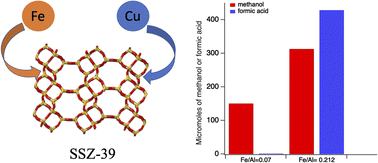
Here iron and copper containing zeolites are reported for the liquid phase oxidation of methane to methanol using hydrogen peroxide (H2O2) as an oxidant. Iron-exchanged SSZ-39 favors formic acid formation while Fe, Cu-SSZ-39 samples with low iron contents shift the selectivity towards methanol with no observable formic acid formation. It was also observed that how the metals are loaded into the zeolite is integral to their catalytic performance. A two-step method wherein iron-exchanged SSZ-39 had copper added to it (Cu/Al = 0.196 and Fe/Al = 0.07) showed promising results compared to other approaches of loading both metals, resulting in a methanol production rate of 5.4 mmol (gcat−1 h−1) after one hour of reaction time. Interestingly, varying the Fe/Cu ratio of the samples enabled the possibility to increase the amount of oxygenates and shift the selectivity. The most active catalyst was Fe, Cu-SSZ-39(t) with Fe/Al = 0.212, Cu/Al = 0.031 that produced formic acid and methanol at a rate of 11.2 and 15.3 mmol (gcat−1 h−1). In general, it is observed that Fe-SSZ-39 and Fe, Cu-SSZ-39 produce more oxygenates than Fe-ZSM-5 and Fe, Cu-ZSM-5 under the same experimental conditions. Analogous to the gas phase oxidation of methane to methanol, the steric constraints of the small-pore zeolite could be one possible reason for this.
 Please wait while we load your content...


