


 PLATFORM UPDATE:


Filtration behavior and associated mechanisms of kaolinite and illite with emphasis on pH effect
 *abc
*abc
Abstract
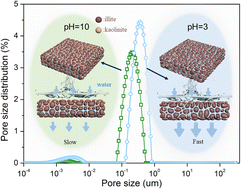
The filterability and mechanisms of individual kaolinite and illite particles and their mixture have been investigated in aqueous solutions at different pH values by measuring the filtration rate and chord length distributions. The filtration rate decreased with pH values varying from 3 to 10, while the chord length distribution results showed that the clay mixture aggregated most significantly at pH 3. The particle interaction energy of the clay mixture, calculated according to the Derjaguin–Landau–Verwey–Overbeek (DLVO) theory, was determined to be attractive at pH 3. The pore size distribution (PSD) and porosity of the clay mixture filter cake were measured using the low-field nuclear magnetic resonance (LF-NMR) nanopore analyzer. The total porosity of the filter cake at pH 3 was higher than that at pH 10, leading to a higher filtration rate. It has been found from this study that the clay filterability depends on filter cake porosity, microstructure and the interaction of particles in the filter cake.
 Please wait while we load your content...


