


 PLATFORM UPDATE:


Utilization of semiconductor-decorated tungsten trioxide nanowire membranes for the elimination of microorganisms from potable water

Abstract
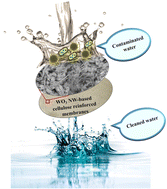
Microbial contamination in drinking water continues to be a significant global issue due to its direct effects on human health, particularly in areas with insufficient sanitation or deteriorating infrastructure. Conventional treatment systems frequently encounter challenges in fully eliminating pathogenic bacteria, underscoring the pressing necessity for innovative, energy-efficient filtration technology to ensure universal access to clean drinking water. In this regard, numerous reconsidered membrane technologies and filtration solutions have been developed and published recently. In this study, tungsten trioxide nanowire (WO3)-based hybrid membranes were prepared using a hydrothermal method followed by a simple impregnation process. The present study shows the removal efficiency of WO3 NW-based hybrid membranes in the filtration experiments of Escherichia coli (E. coli) bacteria and MS2 bacteriophages. The surface of the as-prepared WO3 NW was decorated with iron(III) oxide (Fe2O3) and copper(II) oxide (CuO) nanoparticles, respectively, and cellulose was used as a reinforcement matrix during membrane preparation. Produced hybrid membranes were characterized by micro computed tomography (μCT), Raman spectroscopy, Fourier transform infrared spectroscopy (FT-IR), dynamic light scattering (DLS) and inductively coupled optical emission spectrometry (ICP-OES) techniques. The results showed that the WO3–Fe2O3–cellulose membrane achieved a 90% removal efficiency for E. coli. In comparison, the WO3–CuO–cellulose membrane demonstrated a 2.5 log reduction value (LRV), corresponding to a 99.7% removal efficiency for MS2 bacteriophage. The application of Fe2O3 and CuO nanoparticles for the surface modification of WO3 NW resulted in notable distinctions when comparing the results of the E. coli and MS2 filtering experiments. The observed phenomena can be attributed to electrostatic surface interactions between the membranes and microorganisms, as confirmed by zeta potential measurements. With this study, the authors aim to show a facile, eco-friendly and cost-effective membrane solution for the removal of microorganisms from drinking water.
 Please wait while we load your content...


