Issue 36, 2025, Issue in Progress

Using pseudo-symmetrization to overcome dendrimer surface steric crowding: a birth of l-lysine-β-alanine architecture

Abstract

A synthetic approach to overcoming the surface crowding of polylysine dendrimers is reported. The introduction of a β-alanine unit on the α-amine of L-lysine creates a pseudo-symmetry between the two amino groups, which is found to reduce the steric bias when used as a dendrimer building block, compared with the parent L-lysine. Our findings show that this approach allows the unhindered growth of the L-lysine-β-alanine dendrimers until generation 8, thus significantly increasing the generation at which de Gennes' critical dense state of surface functional groups is reached, compared with traditional polylysine dendrimers. Highly uniform high molecular weight nanostructures have been isolated, purified, and characterized by NMR spectroscopy, matrix-assisted laser desorption ionization-time of flight (MALDI-TOF) mass spectroscopy, and gel-permeation chromatography (GPC).
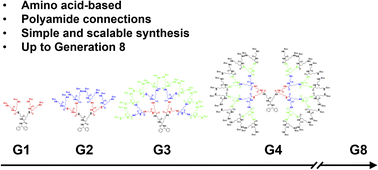
Graphical abstract: Using pseudo-symmetrization to overcome dendrimer surface steric crowding: a birth of l-lysine-β-alanine architecture

Supplementary files

Article information

Article type
Paper
Submitted
06 Jul 2025
Accepted
11 Aug 2025
First published
19 Aug 2025
This article is Open Access
Creative Commons BY-NC license

RSC Adv., 2025,15, 29230-29237

Using pseudo-symmetrization to overcome dendrimer surface steric crowding: a birth of L-lysine-β-alanine architecture

Y. Lo, A. Tsourkas and D. Jishkariani, RSC Adv., 2025, 15, 29230 DOI: 10.1039/D5RA04817F

This article is licensed under a Creative Commons Attribution-NonCommercial 3.0 Unported Licence. You can use material from this article in other publications, without requesting further permission from the RSC, provided that the correct acknowledgement is given and it is not used for commercial purposes.

To request permission to reproduce material from this article in a commercial publication, please go to the Copyright Clearance Center request page.

If you are an author contributing to an RSC publication, you do not need to request permission provided correct acknowledgement is given.

If you are the author of this article, you do not need to request permission to reproduce figures and diagrams provided correct acknowledgement is given. If you want to reproduce the whole article in a third-party commercial publication (excluding your thesis/dissertation for which permission is not required) please go to the Copyright Clearance Center request page.

Read more about how to correctly acknowledge RSC content.

Social activity

Spotlight

Advertisements