


 PLATFORM UPDATE:


Multifunctional PVDF membranes incorporating graphene, TiO2, and nanocellulose: synergistic effects on filtration and antifouling performance

Abstract
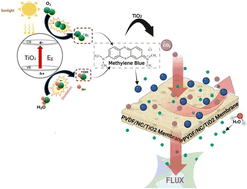
Methylene blue (MB) remains one of the most resilient contaminants in industrial wastewater which presents serious threats to both environmental integrity and human health. Its high chemical stability and resistance to natural degradation render most conventional treatment methods ineffective. As such, this study aimed to develop a multifunctional nanocomposite membrane that mitigates membrane fouling, enhances dye separation, and improves water permeability. Correspondingly, a modified phase inversion method was employed to fabricate polyvinylidene fluoride (PVDF) membranes reinforced with bamboo-derived nanocellulose (NC), titanium dioxide (TiO2), and varying graphene (GR) contents (0–1 wt%). Characterization through FTIR confirmed the successful integration of GR through the attenuation of semi-ionic C–F bonds and the emergence of C![[double bond, length as m-dash]](https://www.rsc.org/images/entities/char_e001.gif) C stretching bands while XRD results revealed that all membranes retained their β-phase crystallinity with slight enhancements in peak intensity attributed to structural modification by GR. Besides, FESEM and EDX analyses revealed that GR-loaded membranes exhibited improved pore morphology, greater surface porosity, and increased carbon content, with average pore size rising from 4.89 × 10⁻³ μm to 13.56 × 10⁻³ μm and porosity from 79.68% to 84.86%, indicating enhanced structural openness, interconnectivity, and effective GR dispersion within the membrane matrix. Experimental results revealed that the membrane with 0.6 wt% GR (PVDF-NC/TiO2/GR3) achieved a balanced performance with superior pore interconnectivity contributing to water permeation flux of 270.74 L m−2 h−1. This pore architecture favoured water transport without significant loss in selectivity. In terms of separation performance, the 0.4 wt% GR membrane achieved the highest dye rejection of 97% and a flux recovery ratio (FRR) of 98%, which confirmed its strong antifouling properties under UV irradiation. The adsorption behaviour was best described by the Langmuir isotherm model with high correlation coefficients (R2 = 0.85 to 0.99), indicating monolayer dye uptake on uniform active sites. The PVDF-NC/TiO2/GR3 showed the highest adsorption capacity (Qmax = 1.866 mg g−1), supported by R2 = 0.96. In contrast, the control membrane (PVDF-NC/TiO2) exhibited the strongest dye-binding affinity (KL = 478 L mg−1, R2 = 0.97). Overall, this study introduces a practical nanocomposite membrane that effectively mitigates the conventional trade-off between permeability and selectivity by delivering high dye removal, strong antifouling performance, and promising applicability for industrial wastewater treatment. Comparative analysis with previously reported PVDF-based membranes further highlighted the superior performance of the developed formulation.
C stretching bands while XRD results revealed that all membranes retained their β-phase crystallinity with slight enhancements in peak intensity attributed to structural modification by GR. Besides, FESEM and EDX analyses revealed that GR-loaded membranes exhibited improved pore morphology, greater surface porosity, and increased carbon content, with average pore size rising from 4.89 × 10⁻³ μm to 13.56 × 10⁻³ μm and porosity from 79.68% to 84.86%, indicating enhanced structural openness, interconnectivity, and effective GR dispersion within the membrane matrix. Experimental results revealed that the membrane with 0.6 wt% GR (PVDF-NC/TiO2/GR3) achieved a balanced performance with superior pore interconnectivity contributing to water permeation flux of 270.74 L m−2 h−1. This pore architecture favoured water transport without significant loss in selectivity. In terms of separation performance, the 0.4 wt% GR membrane achieved the highest dye rejection of 97% and a flux recovery ratio (FRR) of 98%, which confirmed its strong antifouling properties under UV irradiation. The adsorption behaviour was best described by the Langmuir isotherm model with high correlation coefficients (R2 = 0.85 to 0.99), indicating monolayer dye uptake on uniform active sites. The PVDF-NC/TiO2/GR3 showed the highest adsorption capacity (Qmax = 1.866 mg g−1), supported by R2 = 0.96. In contrast, the control membrane (PVDF-NC/TiO2) exhibited the strongest dye-binding affinity (KL = 478 L mg−1, R2 = 0.97). Overall, this study introduces a practical nanocomposite membrane that effectively mitigates the conventional trade-off between permeability and selectivity by delivering high dye removal, strong antifouling performance, and promising applicability for industrial wastewater treatment. Comparative analysis with previously reported PVDF-based membranes further highlighted the superior performance of the developed formulation.
 Please wait while we load your content...


