Issue 50, 2025, Issue in Progress

Label-free fluorescent probe based on upconversion nanoparticles for convenient detection of cytochrome c

Abstract

Abnormal levels of cytochrome c (Cyt c) are closely associated with various human diseases, including neurodegenerative disorders and cancers. Therefore, the quantitative detection of Cyt c holds significant value for both disease diagnosis and therapeutic efficacy assessment. Herein, we developed two novel label-free fluorescent probes for sensitive Cyt c detection based on upconversion nanoparticles: one functionalized with poly (ethylene glycol) ylated phospholipid (DSPE-PEG) alone, and the other co-functionalized DSPE-PEG combined with triphenylphosphine. The electrostatic interaction generates resulting in a quantifiable fluorescence quenching effect. The proposed method demonstrated excellent performance in the detection of Cyt c in complex matrices, including cell lysates and human blood sample. Notably, it offers significant advantages over conventional assays by simplifying sample preparation, reducing operational steps, and providing rapid response with distinct observable signals, showing great potential for clinical diagnosis and therapeutic monitoring.
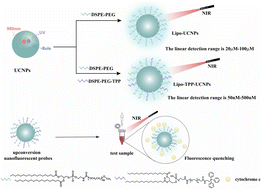
Graphical abstract: Label-free fluorescent probe based on upconversion nanoparticles for convenient detection of cytochrome c

Supplementary files

Article information

Article type
Paper
Submitted
28 Jun 2025
Accepted
13 Oct 2025
First published
03 Nov 2025
This article is Open Access
Creative Commons BY-NC license

RSC Adv., 2025,15, 42443-42449

Label-free fluorescent probe based on upconversion nanoparticles for convenient detection of cytochrome c

H. Zheng and Z. Wu, RSC Adv., 2025, 15, 42443 DOI: 10.1039/D5RA04602E

This article is licensed under a Creative Commons Attribution-NonCommercial 3.0 Unported Licence. You can use material from this article in other publications, without requesting further permission from the RSC, provided that the correct acknowledgement is given and it is not used for commercial purposes.

To request permission to reproduce material from this article in a commercial publication, please go to the Copyright Clearance Center request page.

If you are an author contributing to an RSC publication, you do not need to request permission provided correct acknowledgement is given.

If you are the author of this article, you do not need to request permission to reproduce figures and diagrams provided correct acknowledgement is given. If you want to reproduce the whole article in a third-party commercial publication (excluding your thesis/dissertation for which permission is not required) please go to the Copyright Clearance Center request page.

Read more about how to correctly acknowledge RSC content.

Social activity

Spotlight

Advertisements