


 PLATFORM UPDATE:


Uric acid electrochemical biosensor based on a laser-induced graphene electrode modified with a Honey-mediated nanocomposite of reduced graphene oxide and bimetallic silver–cobalt

Abstract
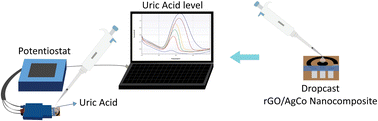
Abnormal uric acid (UA) levels are commonly linked to several metabolomic or internal organ problems. Electrochemical-based tests have been used as alternative early screening methods to determine the levels of biomarkers, including UA. Electrochemical biosensors based on laser-induced graphene (LIG) electrodes could offer a promising alternative to realize a low-cost biosensor for biomarker detection. In this study, an LIG electrode was modified with a nanocomposite composed of reduced graphene oxide and silver–cobalt bimetal (rGO/AgCo), resulting in its enhanced sensitivity and selectivity for the detection of UA. Furthermore, to promote eco-friendliness, honey was utilized as the mediator to reduce and stabilize the nanoparticles during the creation of the nanocomposite. Differential pulse voltammetry (DPV) test results revealed that the nanocomposite-modified electrode exhibited excellent selectivity and electrochemical characteristics for the detection of UA, with a linear range of 0.1–2000 μM, limit of detection (LOD) of 3.75 μM, limit of quantification (LOQ) of 11.36 μM, and sensitivity of 1.76 μA μM−1 cm−2. These results indicated the synergistic effect of the rGO/AgCo nanocomposite in facilitating a higher conductivity and larger surface sensing area for the LIG electrode. Moreover, with such a low concentration level detection capability, the nanocomposite-modified electrode is suitable to be used for the detection of UA in human body fluids, such as sweat, urine, or blood. Thus, in the future, it could potentially realize a UA screening test alternative with excellent selectivity and sensitivity.
 Please wait while we load your content...


