


 PLATFORM UPDATE:

Biogenic synthesis and antimicrobial properties of rare-earth element nanoparticles using Moringa oleifera
 *a
*a
Abstract
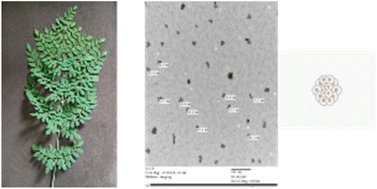
This research demonstrates a green biological method for producing mixed rare-earth oxide nanoparticles (multi-REO NPs) through Moringa oleifera leaf extract in water. A light rare-earth oxide (LREO) cake concentrate, containing mainly the oxides of La, Ce, Pr, and Nd, served as the precursor for the metal ions. The aqueous extract from M. oleifera leaves due to its rich phytochemical contents served dual functions as a bioreducing and capping agent. The formation of nanoparticles was verified through UV-vis spectroscopy, which displayed a characteristic absorption peak at 311 nm corresponding to CeO2. Fourier transform infrared (FTIR) spectroscopy confirmed the formation of the metal oxide core, with characteristic metal–oxygen (M–O) vibrational bands observed below 620 cm−1. XRD analysis revealed that the synthesized multi-REO NPs were predominantly nanocrystalline. Transmission electron microscopy (TEM) revealed nanoparticles with varied morphologies and an average diameter of 29.36 nm (ranging from 16 to 50 nm), further confirmed by dynamic light scattering (DLS), which showed a hydrodynamic diameter of 29.3 nm. Coupled scanning electron microscopy (SEM) and energy-dispersive X-ray spectroscopy (EDS) confirmed the presence of La, Ce, and Nd. The synthesized multi-REO NPs were nanocrystalline, exhibiting broad diffraction peaks and indicating significantly smaller crystallite sizes compared to the highly crystalline starting REO cake. The multi-REO NPs demonstrated remarkable antimicrobial activity, with agar-well assay inhibitory zones against Gram-positive (Staphylococcus aureus and Bacillus cereus) of 3.30 and 3.00 cm, respectively; against Gram-negative (Escherichia coli); and against fungal strains (Candida albicans and Aspergillus niger) of 2.5 and 2 cm, respectively. The nanoparticles were notably most effective against S. aureus.
 Please wait while we load your content...


