


 PLATFORM UPDATE:

CO2 adsorption and activation on AuO(CO2)n−/+ (n = 1–3) clusters: a theoretical study

Abstract
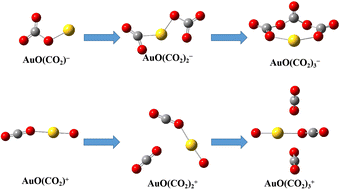
The geometric and electronic properties of AuO(CO2)n−/+ (n = 1–3) clusters have been systematically investigated using density functional theory (DFT). All anionic ground states are singlets, whereas the cationic counterparts are triplets. Anions prefer distorted CO3-like binding and, at n = 3, an oxygen-bridged ring, while cations retain near-linear CO2 with modest perturbation. The thermodynamics at 298 K show favorable first and second adsorption on anions and an unfavorable third step, consistent with site saturation. In cations the first step is favorable, the second weakly favorable, and the third slightly unfavorable. Natural population analysis (NPA) and Natural bond orbital (NBO) analyses indicate stronger charge acceptance and higher Au–O bond order in anions than in cations. These results identify charge state and saturation as the primary controls of bonding across this size range.
 Please wait while we load your content...


