


 PLATFORM UPDATE:


Metal–organic framework/MXene-based materials: preparations and applications
 *a
*a
Abstract
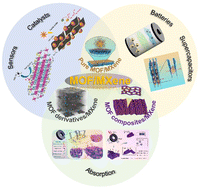
Metal–organic framework (MOF) materials have attracted significant attention due to their high surface area and adjustable pore structure, which enable potential applications across various fields. However, their practical application is often hindered by poor electrical conductivity and limited structural stability. Integrating MOF with two-dimensional transition metal carbides/nitrides (MXene) offers a powerful strategy to overcome these limitations, synergistically combining the porous architecture of MOF with the exceptional conductivity and mechanical robustness of MXenes. Notably, the performance of MOF/MXene-based materials is governed by the diversification of MOF components. This review provides a systematic and comprehensive analysis of MOF/MXene-based materials, emphasizing a component-driven design approach. These materials are classified into three different types: pure MOF/MXene, MOF composite/MXene, and MOF derivative/MXene, and their synthetic strategies are detailed, including in situ growth, solvothermal/hydrothermal methods, self-assembly, and co-precipitation method. Further exploration was conducted on their advanced performance in multifunctional applications such as batteries, supercapacitors, sensors, catalysts, and electromagnetic wave absorbing materials.
- This article is part of the themed collection: 2025 Reviews in RSC Advances
 Please wait while we load your content...


