


 PLATFORM UPDATE:


Fabrication and characterization of electrospun polycaprolactone/Urechis unicinctus derived-ECM composite scaffolds for small-diameter vascular grafts
 a
and
Hyeongjin
Lee
*a
a
and
Hyeongjin
Lee
*a
Abstract
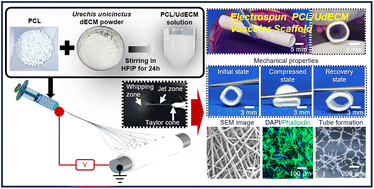
Small-diameter vascular grafts (SDVGs; ≤6 mm inner diameter) often fail due to thrombosis, poor endothelialization, and low patency. To overcome these limitations, we developed electrospun composite scaffolds incorporating decellularized Urechis unicinctus ECM (UdECM), a marine invertebrate source rich in collagen, glycosaminoglycans, and elastin. UdECM was blended with polycaprolactone (PCL) at 1, 5, and 10 wt% and electrospun into fibrous matrices. We characterized scaffold hydrophilicity (water contact angle, water uptake), mechanical properties, and cell behaviors (e.g., viability, proliferation, tube formation) using EA.hy926 endothelial cells, and performed in vitro blood clotting assays. UdECM-containing scaffolds exhibited improved hydrophilicity and mechanical strength compared to pure PCL, with the 10 wt% UdECM scaffold demonstrating the highest stiffness while retaining suitable elongation. Endothelial cells grown on UdECM-enhanced scaffolds showed increased viability and tube formation, indicative of a pro-angiogenic environment. Anticoagulant tests revealed reduced blood cell adhesion with higher UdECM content. These findings underscore the potential of marine-derived ECM to enhance the functionality of synthetic vascular grafts by promoting both endothelialization and thromboresistance.
 Please wait while we load your content...


