Issue 34, 2025

Highly phase-separated alternating copolymer of alkyl vinyl ether and sulfonic acid group-containing trifluoro vinyl ether

Abstract

This study explores the development of novel cation exchange membranes (CEMs) by synthesizing alternating copolymers of perfluorosulfonic acid monomers and alkyl vinyl ethers with varying chain lengths. Unlike traditional Nafion-based CEMs, which form cluster-channel morphologies, the newly synthesized copolymers exhibit well-defined lamellar structures. Small-angle X-ray scattering (SAXS) and transmission electron microscopy (TEM) analyses revealed that increasing the alkyl chain length enhances the area of these structures. Moreover, self-diffusion coefficient measurements by PFG-NMR showed that water diffusivity increased with longer side chains, despite a decrease in ion exchange capacity (IEC). This inverse relationship highlights the importance of morphological control in optimizing membrane transport properties. The findings demonstrate that integrating hydrocarbon and fluorocarbon components enables the design of distinct phase-separated structures, expanding the landscape of structure–property relationships in ion-conducting materials. These insights offer new strategies for engineering high-performance membranes for energy and water-related applications.
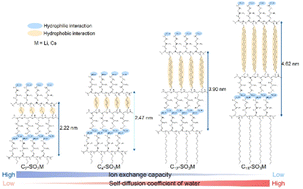
Graphical abstract: Highly phase-separated alternating copolymer of alkyl vinyl ether and sulfonic acid group-containing trifluoro vinyl ether

Supplementary files

Article information

Article type
Paper
Submitted
20 Jun 2025
Accepted
31 Jul 2025
First published
06 Aug 2025
This article is Open Access
Creative Commons BY-NC license

RSC Adv., 2025,15, 27924-27932

Highly phase-separated alternating copolymer of alkyl vinyl ether and sulfonic acid group-containing trifluoro vinyl ether

K. Hori, S. Miyanishi and T. Yamaguchi, RSC Adv., 2025, 15, 27924 DOI: 10.1039/D5RA04403K

This article is licensed under a Creative Commons Attribution-NonCommercial 3.0 Unported Licence. You can use material from this article in other publications, without requesting further permission from the RSC, provided that the correct acknowledgement is given and it is not used for commercial purposes.

To request permission to reproduce material from this article in a commercial publication, please go to the Copyright Clearance Center request page.

If you are an author contributing to an RSC publication, you do not need to request permission provided correct acknowledgement is given.

If you are the author of this article, you do not need to request permission to reproduce figures and diagrams provided correct acknowledgement is given. If you want to reproduce the whole article in a third-party commercial publication (excluding your thesis/dissertation for which permission is not required) please go to the Copyright Clearance Center request page.

Read more about how to correctly acknowledge RSC content.

Social activity

Spotlight

Advertisements