


 PLATFORM UPDATE:


Comparison of adsorption mechanisms of tungstate ions on different clay minerals
 *abc
*abc
Abstract
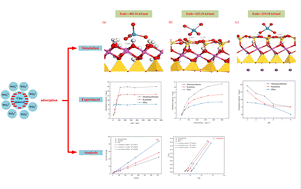
Tungsten, widely used in industry, can cause ecological risks like soil degradation and plant growth inhibition due to its migration and accumulation in the environment. Studying its adsorption mechanisms helps understand its transformation laws, accurately evaluate ecological risks, and develop control strategies. This study combines first-principles simulations based on DFT (density functional theory) with experiments to explore the different adsorption behaviors of tungsten (WO42−) on three clay minerals: kaolinite, montmorillonite, and illite. Adsorption experiments show that lowering the solution pH, increasing the initial concentration, and extending the adsorption time all enhance WO42− adsorption on the three minerals. A higher pH increases the negative charge on the minerals' surfaces, boosting electrostatic repulsion and reducing WO42− adsorption. Adsorption kinetics and isotherm studies indicate that the adsorption process on the three minerals follows pseudo-second-order kinetics and the Langmuir model, suggesting chemisorption dominance. The adsorption rate for WO42− is illite > kaolinite > montmorillonite, while the adsorption capacity at equilibrium is montmorillonite > kaolinite > illite. First-principles studies reveal that WO42− forms one Al–O coordination bond (1.889 Å) on kaolinite (001), two Si–O bonds (1.799 Å, 1.889 Å) on montmorillonite, and two Si–O bonds (both 1.800 Å) on illite (001). The adsorption of WO42− on the (001) faces of these minerals is mainly chemisorption, with adsorption energies of −166.94 kJ mol−1 (kaolinite), −178.52 kJ mol−1 (montmorillonite), and −112.65 kJ mol−1 (illite). WO42− adsorbs most easily on montmorillonite (001) due to its lowest adsorption energy and highest stability, followed by kaolinite (001), and least easily on illite (001).
 Please wait while we load your content...


