


 PLATFORM UPDATE:


Novel Janus XGa–PbP (X = S, Se) monolayers: excellent photocatalysts for overall water splitting

Abstract
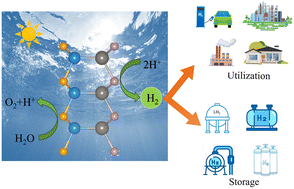
The search for efficient and sustainable materials for solar-driven water splitting has intensified with the emergence of two-dimensional (2D) Janus structures. In this work, we theoretically design and explore two novel Janus monolayers, SGa–PbP and SeGa–PbP, using first-principles calculations. Our results reveal that both monolayers are dynamically, thermally, and mechanically stable, and exhibit direct band gaps (0.93 eV for SGa–PbP and 1.24 eV for SeGa–PbP) ideally suited for visible-light absorption. Impressively, these systems display strong optical absorption in the visible and ultraviolet regions, with absorption coefficients reaching 105 cm−1. The asymmetric structure induces built-in electric fields that enhance charge separation, while the PbP surface provides active hydrogen adsorption sites with nearly optimal free energy |ΔGH*| values for hydrogen evolution. Most notably, the corrected solar-to-hydrogen conversion efficiencies reach 40.69% and 31.75% for SGa–PbP and SeGa–PbP, respectively-significantly surpassing many state-of-the-art 2D photocatalysts. These findings position XGa–PbP Janus monolayers as highly promising candidates for next-generation solar hydrogen production technologies.
 Please wait while we load your content...


