Issue 49, 2025

Olive leaf extract as a natural antioxidant and antimicrobial additive in biodegradable PLA film and its potential utilization in active packaging

Abstract

This study explores the development of a biodegradable film based on plasticized polylactic acid (PLA), incorporating olive leaf extract (OLE) to impart antimicrobial and antioxidant properties for potential use in the packaging of fruits and sensitive vegetables. Films were prepared using the casting method with triacetin as a plasticizer and three OLE concentrations (3%, 5%, and 8%). The addition of OLE induced notable changes in the colour, mechanical, and thermal properties of the films. The obtained films exhibited potent antioxidant activity and notable antibacterial effects against different bacterial strains. Migration tests, conducted by assessing the phenolic content and HPLC-DAD analysis to quantify released phenolic compounds, revealed a moderate migration rate below a 5% OLE content. Biodegradation tests demonstrated high carbon mineralization rates exceeding 50% over 60 days under burial and composting conditions. The PLA–OLE film effectively preserved high quality for 21 days at 4 °C, significantly extending the shelf life when used as active packaging for cherry tomatoes.
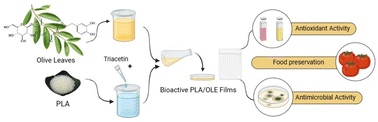
Graphical abstract: Olive leaf extract as a natural antioxidant and antimicrobial additive in biodegradable PLA film and its potential utilization in active packaging

Article information

Article type
Paper
Submitted
17 Jun 2025
Accepted
10 Oct 2025
First published
31 Oct 2025
This article is Open Access
Creative Commons BY-NC license

RSC Adv., 2025,15, 41978-41994

Olive leaf extract as a natural antioxidant and antimicrobial additive in biodegradable PLA film and its potential utilization in active packaging

S. Soltani, S. Hajji, N. Allouche and S. Boufi, RSC Adv., 2025, 15, 41978 DOI: 10.1039/D5RA04293C

This article is licensed under a Creative Commons Attribution-NonCommercial 3.0 Unported Licence. You can use material from this article in other publications, without requesting further permission from the RSC, provided that the correct acknowledgement is given and it is not used for commercial purposes.

To request permission to reproduce material from this article in a commercial publication, please go to the Copyright Clearance Center request page.

If you are an author contributing to an RSC publication, you do not need to request permission provided correct acknowledgement is given.

If you are the author of this article, you do not need to request permission to reproduce figures and diagrams provided correct acknowledgement is given. If you want to reproduce the whole article in a third-party commercial publication (excluding your thesis/dissertation for which permission is not required) please go to the Copyright Clearance Center request page.

Read more about how to correctly acknowledge RSC content.

Social activity

Spotlight

Advertisements