


 PLATFORM UPDATE:


Evaluation of alginate/poly(vinyl alcohol)/BaSO4 hydrogels for nucleus pulposus regeneration

Abstract
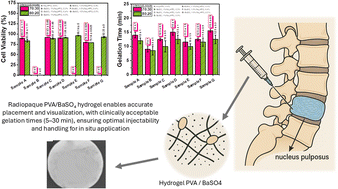
Intervertebral disc degeneration is a major contributor to lower back pain worldwide, underscoring the urgent need for effective, minimally invasive regenerative therapies. One of the critical challenges in nucleus pulposus (NP) replacement lies in developing injectable hydrogels with optimal gelation behavior, radiopacity, mechanical properties, and biocompatibility. This study investigates the influence of varying concentrations of Na2HPO4 (0.3%, 0.4%, 0.5%) and BaSO4 (1%, 1.5%) in ALG/PVA hydrogels through a series of gelation time measurements, radiopacity analysis, mechanical testing, and in vitro biocompatibility assays. The optimal formulation, containing 1.5 wt% BaSO4 and 0.4 wt% Na2HPO4, achieved a gelation time of 12.5 ± 0.5 minutes, radiopacity of 71–74%, elastic modulus of 0.055 ± 0.015 MPa, and cell viability above 90%, fulfilling key criteria for NP scaffold performance. Although compressive strength remained below physiological requirements, the formulation demonstrated excellent injectability, structural integrity, and biological response. This study offers a novel strategy by combining retarding and radiopaque agents in a single hydrogel system, contributing to the advancement of injectable biomaterials for intervertebral disc regeneration.
 Please wait while we load your content...


