


 PLATFORM UPDATE:


Plasmonic effect-driven strategy for boosting photoelectrocatalytic degradation of rhodamine B using a SnS2/Au self-supported photoelectrode
 *a
*a
Abstract
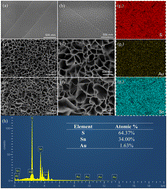
Photoelectrocatalytic degradation of pollutants is regarded as one of the green disposal schemes for water pollutants under the “dual carbon” strategy. In this paper, a gold-based tin disulfide self-supporting photoelectrode (SnS2–Au/Ti foil) was successfully prepared by a two-step method and applied to the photoelectrocatalytic degradation of rhodamine B (RhB) pollutants. The phase structure of the self-supported photoelectrode was characterized by scanning electron microscopy, X-ray diffraction, ultraviolet-visible spectrophotometry, and fluorescence spectrophotometry. The test results for photoelectrocatalytic degradation performance demonstrated that the degradation performance of the pollutant RhB was significantly enhanced via the plasmonic effect of gold in synergy with the intrinsic photocatalytic characteristics of the tin sulfide semiconductor. The photoelectrocatalytic degradation efficiency of the self-supported photoelectrode reached 81.25% within 120 minutes. The composite electrode SnS2–Au/Ti foil demonstrated an 38.18% and 8.45% increase in photoelectrocatalytic degradation of RhB efficiency over the single Au and SnS2 electrodes, respectively. The plasmonic effect-driven strategy for boosting photoelectrocatalytic efficiency opens new perspectives for RhB degradation.
 Please wait while we load your content...


