


 PLATFORM UPDATE:


TiO2-enhanced fly ash for advanced treatment of persistent organics (POCs) in landfill leachate via hybrid ozonation–peroxymonosulfate: degradation efficiency and machine learning modeling

Abstract
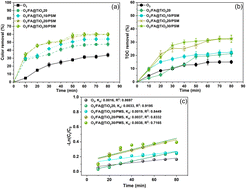
Landfill leachate is a major environmental concern because of its high content of persistent organic compounds (POCs), which require advanced treatment techniques. This study introduces a novel hybrid ozonation–TiO2-modified fly ash composite (FA@TiO2) process enhanced by a peroxymonosulfate (PMS) for POC degradation in landfill leachate. The FA@TiO2 composite, synthesized via the sol–gel method with optimal 20% TiO2 loading, leverages fly ash's cost-effectiveness and TiO2's catalytic prowess. Experiments revealed that under optimized conditions—pH 9, PMS dosage of 300 mg L−1, and FA@TiO2 dosage of 1.00 g L−1 – the system achieved 77.90% color removal and 61.59% total organic carbon (TOC) removal after 80 min, with a pseudo-first-order rate constant of 0.0087 min−1. The synergy between FA's metal oxides and TiO2 nanoparticles enhances reactive oxygen species (ROS) generation, including hydroxyl (˙OH) and sulfate (SO4˙−) radicals, driving POC mineralization. Reusability tests showed the catalyst retained 67.52% color and 40.62% TOC removal efficiencies after five cycles, indicating practical viability despite a performance decline. Radical scavenger studies confirmed OH radicals' dominant role in TOC degradation. This approach offers a sustainable, efficient solution for leachate treatment by repurposing industrial waste and optimizing operational parameters, advancing the application of advanced oxidation processes in environmental remediation. This study evaluates the performance of four machine learning models – Linear Regression, Artificial Neural Network (ANN), Random Forest (RF), and Support Vector Machine (SVM) – in predicting polycyclic organic compound degradation efficiency within the O3/FA@TiO2/PMS system, with ANN demonstrating superior accuracy and generalization (R2 = 0.994, RMSE = 1.18, MAE = 0.956).
 Please wait while we load your content...


