


 PLATFORM UPDATE:


Light-triggered degradable bridged polysilsesquioxane nanoplatforms for spatiotemporally controlled drug release

Abstract
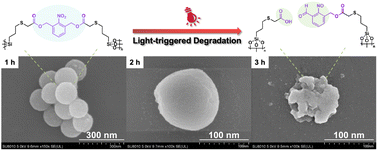
Developing stimuli-responsive nanoplatforms is a promising strategy for controlling the release of targeted molecules. In this study, nitrobenzyl ester was chosen as a photoresponsive moiety to functionalize an organic bridged linker, facilitating the synthesis of a photoresponsive silane, namely 2-nitro-1,3-phenyl bis(methylene mercaptoacetate ester) bridged trimethoxysilane (SMS). Light-triggered degradable bridged polysilsesquioxane nanoparticles (SMPS) were achieved through hydrolysis-condensation reactions using SMS as a precursor in suspension polymerization. Upon irradiation at 365 nm for three hours, the particle size of SMPS decreased from 138 ± 20 nm to 103 ± 43 nm. The target molecule, evodiamine (Evo), was efficiently loaded onto SMPS through hydrophobic and electrostatic attractions, constructing a light-controlled release system, Evo@SMPS. The results of in vitro experiments demonstrate that this photoresponsive platform exhibits effective light-triggered release behavior upon 365 nm. Under an irradiation intensity of 100 mW cm−2 for 12 hours, the cumulative release rate of Evo reached up to 92.3%, allowing precise control over the release amount, timing, and location of target molecules. This light-triggered degradable bridged polysilsesquioxane carrier platform with high biocompatibility holds significant potential and prospects for broad application in multifunctional controlled release systems.
 Please wait while we load your content...


