


 PLATFORM UPDATE:


Efficient removal of selected neonicotinoids from single and combined systems using CuO/rGO modified musa parasidiaca biochar: insight into cost analysis
 *a
Stephen Sunday
Emmanuel,
b
Saheed O.
Sanni,
d
Odunayo T.
Ore,
e
Adewumi Oluwasogo
Dada,
f
Obianuju Patience
Ilo
g
and
*a
Stephen Sunday
Emmanuel,
b
Saheed O.
Sanni,
d
Odunayo T.
Ore,
e
Adewumi Oluwasogo
Dada,
f
Obianuju Patience
Ilo
g
and
Abstract
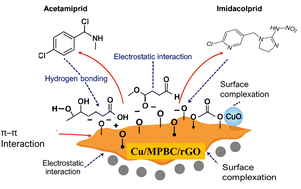
The widespread use of neonicotinoid pesticides, particularly imidacloprid (IMI) and acetamiprid (ACE), has raised environmental concerns due to their persistence and toxicity in aquatic systems. This study investigates the efficacy of copper oxide-modified Musa Parasidiaca peel biochar-supported reduced graphene oxide (Cu/MPBC/rGO) as a novel adsorbent for removing IMI and ACE from aqueous solutions. The synthesized composite was characterized using scanning electron microscopy (SEM), Fourier Transform Infrared Spectroscopy (FTIR), X-ray diffraction spectroscopy (XRD) etc, to elucidate its morphology, surface chemistry, crystallinity, and porosity. Adsorption experiments were conducted to examine the influence of pH, contact time, adsorbent dose and adsorbate concentration. The adsorption kinetics followed the mixed order kinetic model, and the equilibrium data were best described by the Langmuir isotherm, indicating monolayer adsorption. Cu/MPBC/rGO exhibited high adsorption capacities of 62.19 mg g−1 for IMI and 32.78 mg g−1 for ACE. Reusability studies confirmed the material's stability and efficiency over multiple cycles. These findings proved the potential of Cu/MPBC/rGO as an efficient and sustainable adsorbent for the removal of neonicotinoid pesticides from contaminated water.
 Please wait while we load your content...


