


 PLATFORM UPDATE:

CO2/N2 selectivity with high efficiency using new flexible coordinate organic polymer-based core–shell
 *b
*b
Abstract
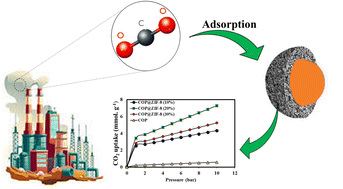
In this study, organic compounds such as coordinate organic polymers (COPs) and metal–organic frameworks (MOFs) have been investigated as a known technology for CO2 and nitrogen (N2) adsorption at low and high pressures. The combination of MOFs and COPs is an important innovation in porous materials for gas adsorption and separation. By exploiting the complementary properties of both, this approach improves adsorption performance, stability, and selectivity. This approach reduces the limitations of each material and opens up new opportunities for developing efficient and sustainable adsorbents. These compounds are efficient and cost-effective. First, the COP and COP@ZIF-8 core–shell were synthesized by solvothermal method and then characterized using famous techniques FT-IR, XRD, BET, TEM, HR-TRM, SEM, EDX/Mapping, TGA, and XPS to determine their physicochemical properties. Nanosorbents were tested for adsorption and separation of CO2/N2. The results showed that the modification of COP with ZIF-8 increased its CO2 adsorption capacity from 0.209 to 3.425 mmol g−1 at 1 bar and 300.15 K. In addition, the adsorption selectivity of COP@ZIF-8 (20%) and COP@ZIF-8 (30%) core–shells is significantly (207.752 and 200.592 in ambient conditions, respectively) improved compared to pure COP (14.824).
 Please wait while we load your content...


