


 PLATFORM UPDATE:


Enhanced thermoelectric performance of yttrium-doped ZnO ceramics via secondary phase formation and conventional sintering

Abstract
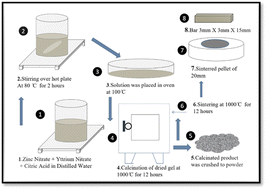
Zinc oxide (ZnO)-based ceramics have been widely studied for thermoelectric applications due to their abundance, non-toxicity, cost-effectiveness, thermal stability, and high Seebeck coefficient. In this work, a series of yttrium (Y)-doped ZnO samples was synthesized using the sol–gel method followed by conventional sintering. The thermoelectric property measurements coupled with detailed structural characterization were systematically performed to establish a structure–property relationship. The X-ray diffraction (XRD) analysis confirms limited substitution of Y at the Zn-site in the lattice of ZnO. The surplus Y-doping results in the formation of the secondary phase Y2O3. The sample with composition Zn0.98Y0.02O exhibited the highest power factor and figure of merit (ZT) values of 0.47 μW cm−1 K−2 and 5.6 × 10⁻⁵, respectively, at 575 K. The outlined study elucidates the effects of Y-doping in ZnO to understand the underlying transport phenomenon in ZnO ceramics.
 Please wait while we load your content...


