


 PLATFORM UPDATE:


Precipitation synthesis and characterization of SnO2@g-C3N4 heterojunctions for enhanced photocatalytic H2 production†

Abstract
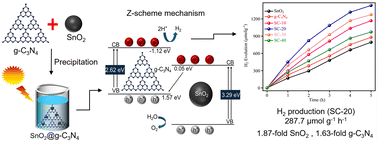
This study reports the development of SnO2@g-C3N4 heterojunctions, a hybrid semiconductor photocatalyst with varying mass percent ratios using a facile precipitation method for hydrogen (H2) production. The synergistic effect between the SnO2 nanoparticles and g-C3N4 sheets suppresses the charge recombination and enhances carrier separation, leading to improved photocatalytic activity. The nanocomposites demonstrate increased hydrogen production across all composites, with SC-20 sample (i.e., 80% SnO2 and 20% g-C3N4) achieving the highest H2 production rate of 287.7 μmol g−1 h−1, that is, 1.87-fold and 1.63-fold higher than that of SnO2 and of g-C3N4 counterparts, respectively. Furthermore, the nanocomposites maintain excellent photostability. Specifically, SC-20 achieves approximately 1500 μmol H2 evolution per 5 hour-cycle. The facile precipitation-based synthesis and enhanced photocatalytic activity of the SnO2@g-C3N4 nanocomposite position it as a reliable, cost-effective, and sustainable candidate for solar-driven hydrogen production and other clean energy applications.
 Please wait while we load your content...


