


 PLATFORM UPDATE:


Isoniazid–rhodanine molecular hybrids: design, synthesis, antimycobacterial activity and computational validation
 *bc
Parvesh
Singh
*a
*bc
Parvesh
Singh
*a
Abstract
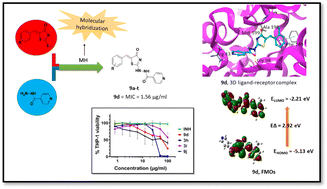
A novel series of isoniazid–rhodanine (INH–Rh) molecular hybrids (9a–t) was prepared and structurally characterized using different spectroscopic techniques, including FTIR, NMR (1H, 13C, HMBC, and HSQC), and HRMS. All the hybrids (9a–t), including their precursors (3a–t and 8a–t), were assessed for their in vitro anti-tubercular activity, alongside the standard anti-tubercular drug, INH. Among them, 9d (MIC = 1.56 μg ml−1), 9j (MIC = 12.50 μg ml−1), and 9n (MIC = 12.50 μg ml−1) displayed the most potent activity against M. tuberculosis (Mtb), with 9d emerging as the most active. However, limited efficacy was observed for seven selected compounds (3h, 3i, 9d, 9j, 9l, 9n, and 9p) against INH-resistant Mtb strains harboring mutations in KatG. Moreover, the Mtb strain overexpressing the enoyl acyl carrier protein reductase (InhA) exhibited significant resistance to 9d, 9j, and 9n, suggesting InhA as their likely target. Molecular docking studies revealed that the binding modes and key intermolecular interactions of the selected compounds closely resembled those of INH, a known inhibitor of InhA. ADME/T analysis indicated favorable pharmacokinetic and safety profiles for the synthesized compounds, while DFT calculations provided further insights into their global reactivity characteristics.
 Please wait while we load your content...


