


 PLATFORM UPDATE:

APTES derived polymer with naphthalimide pendant for the fluorescent sensing of picric acid
 *ab
*ab
Abstract
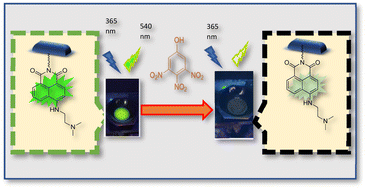
A fluorescent polymer based on silane was synthesised through the functionalization of 4-bromo-1,8-naphthalic anhydride with Aminopropyltriethoxysilane (APTES), followed by polycondensation (referred to as NI@SiP). Subsequently, substitution at the fourth position with N,N-dimethyl ethylene diamine, led to significant enhancement in the weak fluorescence of the NI@SiP, resulting in the polymer, FNI@SiP. Characterization of the polymer material was conducted using FTIR, FESEM, UV-vis, and fluorescent spectroscopy. FNI@SiP displayed improved solubility along with solvent-dependent fluorescence behaviour. Functionalization at the fourth position of the naphthalimide ring enhanced the fluorescence properties of the material, yielding a quantum yield of approximately 23%. The material exhibited quantitative response towards Picric acid (2,4,6-trinitrophenol denoted as TNP) at micromolar levels by fluorescence quenching in the range 1.7 × 10⁻⁶ M to 2.7 × 10⁻⁴ M, with a limit of detection value 2.63 × 10⁻⁸ M, in aqueous media. The quenching mechanism was further elucidated through time-resolved fluorescence decay measurement, revealing a mixed mechanism involved. Furthermore, a thin film polymer sensor was fabricated, leveraging the silane functionality within the polymer, enabling detection of nitroaromatics, thereby presenting new opportunities for practical application.
 Please wait while we load your content...


