


 PLATFORM UPDATE:


Novel AI technology for 4D in situ tracking and physicochemical characterization of inorganic carbonaceous aerosols in air/water

Abstract
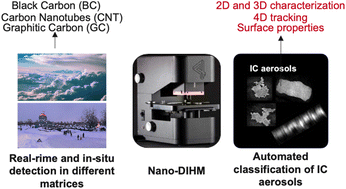
Organic and inorganic aerosol particles in the atmosphere are significant drivers of climate change and pose risks to human health. Biomass burning and combustion processes are substantial sources of these particles, mainly inorganic carbonaceous aerosols (IC) such as black carbon (BC), carbon nanotubes (CNT), and graphite. Despite their environmental relevance, the physicochemical properties of IC are not well characterized, limiting the accuracy of their impact assessments on the Earth's radiative balance and human health. In this study, we demonstrate, for the first time, an in situ and real-time quantitative analysis of the physicochemical properties of IC aerosols, including 3D sizes, shapes, phases, and surfaces along with 4D tracking, using an improved nano-digital in-line holography microscope (AI-Nano-DIHM) with a temporal resolution of 62.5 ms. The AI-Nano-DIHM is integrated with two customized AI-driven software programs, enabling automated classification and physicochemical analysis of BC, CNT, and graphite in air and water environments under stationary and dynamic conditions. Our results demonstrate that AI-Nano-DIHM effectively detects nano- and micrometre-sized IC particles, ranging from 60 nm to 200 μm across all three dimensions (width, height, and length). The results obtained from AI-Nano-DIHM were validated using High-Resolution Scanning/Transmission Electron Microscopy (HR-S/TEM) coupled with energy-dispersive X-ray spectroscopy (EDS). We discuss the significant potential of AI-Nano-DIHM as a cost-effective, rapid, and accurate in situ and real-time technique for characterizing IC aerosols, with important implications for environmental, and health-related outcomes.
- This article is part of the themed collection: 2025 RSC Advances Popular Advances Collection
 Please wait while we load your content...


