


 PLATFORM UPDATE:


Enhancing the antioxidant potential of a coumarin derivative via nickel complexation: synthesis, spectral insights, DFT analysis, and molecular docking
 *d
*d
Abstract
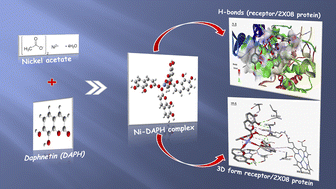
Daphnetin is a naturally occurring coumarin. Despite its numerous positive biological effects, progress in its clinical trial use has been minimal due to its poor water solubility and limited oral bioavailability. This study focuses on the development of a novel and highly stable daphnetin–nickel complex (Ni–DAPH). We present a comprehensive investigation combining experimental and computational approaches to explore the synthesis, characterization, properties, reactivity, and biological activity of the Ni–DAPH complex. The computational studies, based on DFT, included geometry optimization HOMO and LUMO orbitals, UV-visible spectra, infrared (IR) and nuclear magnetic resonance (NMR) spectra, molecular electrostatic potential (MEP), non-covalent interaction (NCI) analysis, quantum theory of atoms in molecules (QTAIM), nonlinear optical (NLO) properties, and antioxidant activity. The molecular electrostatic potential (MEP) analysis identified nucleophilic and electrophilic sites within the complex, while the infrared spectra pinpointed the carbonyl group of the benzopyrone ring as the primary site of complexation. NMR spectroscopy revealed significant proton involvement in charge transfer between the ligand and the nickel center. Natural bond orbital (NBO) analysis indicated nearly equivalent bond angles, suggesting a symmetric geometry. QTAIM analysis confirmed the presence of ionic bonding with a partial covalent character, enhancing the stability of the complex. The ordering of the nickel 3d orbitals is characteristic of a distorted square-planar geometry. The hydrogen atom transfer (HAT) mechanism demonstrated that the Ni–DAPH complex exhibits significantly enhanced antioxidant activity in comparison to the free daphnetin ligand. This result was confirmed by molecular docking with the cytochrome C peroxidase (CCP) and ascorbate peroxidase (APX) HEME-enzymes, using the 2X08 and 1OAF receptor structures. The in silico ADMET study reveals that DAPH complexation improves intestinal absorption and reduces toxicity, enhancing the pharmacological potential of Ni–DAPH.
 Please wait while we load your content...


