Issue 37, 2025, Issue in Progress

Molecular biology insights into levofloxacin-loaded ZnO nanoparticles: a potent strategy against MDR Acinetobacter baumannii

Abstract

Antibiotic resistance is a major global health threat, reducing the effectiveness of standard treatments and increasing mortality rates. This study explores the potential of zinc oxide nanoparticles (ZnO-NPs), synthesized using Streptococcus mitis biomass, to combat levofloxacin-resistant Acinetobacter baumannii. ZnO-NPs were conjugated with levofloxacin (LFX), and their antibacterial activity was evaluated both alone and in combination with antibiotics. Characterization using FTIR, XRD, DLS, FE-SEM-EDX, and UV-Vis confirmed quasi-spherical ZnO-NPs with an average size of 17.62 nm. The antifungal efficacy of the ZnO-NPs nanocomposite was also tested against Candida albicans, Candida glabrata, and Candida krusei at concentrations from 1000 to 62.5 μg mL−1. Mechanistic studies revealed that ZnO-NPs induce membrane lipid peroxidation, elevate malondialdehyde and reactive oxygen species (ROS) levels, and cause DNA damage, protein denaturation, and membrane leakage in bacterial cells. These results indicate that biosynthesized ZnO-NPs, especially when conjugated with antibiotics, exhibit significant antimicrobial activity against multidrug-resistant pathogens, highlighting their potential as alternative therapeutic agents in addressing antibiotic resistance.
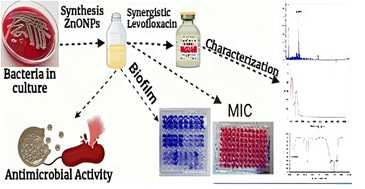
Graphical abstract: Molecular biology insights into levofloxacin-loaded ZnO nanoparticles: a potent strategy against MDR Acinetobacter baumannii

Supplementary files

Article information

Article type
Paper
Submitted
01 May 2025
Accepted
18 Aug 2025
First published
26 Aug 2025
This article is Open Access
Creative Commons BY-NC license

RSC Adv., 2025,15, 30189-30201

Molecular biology insights into levofloxacin-loaded ZnO nanoparticles: a potent strategy against MDR Acinetobacter baumannii

M. E. Ahmed, A. Qassim Al-Awadi and H. S. Mohamed, RSC Adv., 2025, 15, 30189 DOI: 10.1039/D5RA03081A

This article is licensed under a Creative Commons Attribution-NonCommercial 3.0 Unported Licence. You can use material from this article in other publications, without requesting further permission from the RSC, provided that the correct acknowledgement is given and it is not used for commercial purposes.

To request permission to reproduce material from this article in a commercial publication, please go to the Copyright Clearance Center request page.

If you are an author contributing to an RSC publication, you do not need to request permission provided correct acknowledgement is given.

If you are the author of this article, you do not need to request permission to reproduce figures and diagrams provided correct acknowledgement is given. If you want to reproduce the whole article in a third-party commercial publication (excluding your thesis/dissertation for which permission is not required) please go to the Copyright Clearance Center request page.

Read more about how to correctly acknowledge RSC content.

Social activity

Spotlight

Advertisements