


 PLATFORM UPDATE:


Enhanced visible-light photocatalytic degradation of methylene blue via a ternary Ag2O@CuFe2O4@g-C3N4 Z-scheme heterojunction with synergistic Fenton-like reactivity for sustainable water remediation
 *ab
and
*ab
and
Abstract
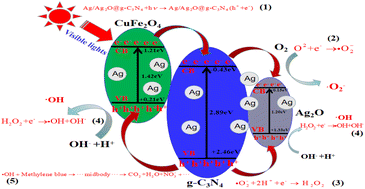
The rational design of heterostructured photocatalysts is critical for addressing organic dye pollution through solar-driven advanced oxidation processes. Herein, a ternary Ag2O@CuFe2O4@g-C3N4 nanocomposite was synthesized via a hydrothermal-precipitation route, integrating Z-scheme charge transfer and Fenton-like reactivity for enhanced visible-light photocatalysis. The composite's activity was evaluated via methylene blue (MB) degradation under a 300 W metal-halide lamp (λ ≥ 420 nm), achieving 99.93% removal within 35 min—2.1× and 1.4× faster than pristine g-C3N4 and binary counterparts, respectively. This performance stems from synergistic effects: (i) a Z-scheme heterojunction between Ag2O, CuFe2O4, and g-C3N4, which spatially separates electron–hole pairs via tailored band alignment; (ii) Fenton-like Fe3+/Cu2+ redox cycles amplifying hydroxyl radical (˙OH) generation; and (iii) uniform dispersion of Ag2O and CuFe2O4 on g-C3N4 nanosheets, maximizing active sites. Radical trapping confirmed ˙OH as the dominant species, with supplementary roles of h+ and ˙O2−. The composite retained >93% activity over ten cycles, demonstrating robust stability due to interfacial coupling and inhibited agglomeration. This work advances the development of multifunctional heterostructures for sustainable water remediation, bridging photocatalysis and Fenton chemistry.
 Please wait while we load your content...


