


 PLATFORM UPDATE:


Aging behavior of polymeric-fiber based vacuum insulation panels
 *a
*a
Abstract
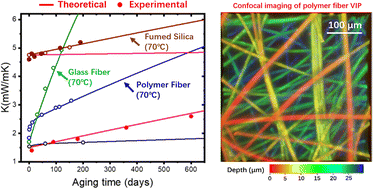
For vacuum insulation panels (VIPs), aging resistance decides the long-term reliability of the products, which is critical for appliance and building applications. As solid and gaseous conduction in VIP has opposite dependence on core material porosity, it is challenging to achieve desired performance in both initial and persistent insulation. In this work, a novel VIP with ultrathin polymeric fiber (diameter of 7 μm) as core material is developed, in which low initial thermal conductivity down to 1.6 mW mK−1 can be achieved with moderate porosity around 85%. Characterized by in situ thermal conductivity and pressure measurements, polymeric fiber-based VIP features a two-phase aging behavior: the short-term aging is governed by the viscoelasticity of the polymeric fiber, and partially reversible upon heating; the long-term aging is dominated by gas permeation, with a low rate around 0.1 mW per mK per year at room temperature. With the excellent combination of low initial conductivity and strong aging resistance, polymer fiber-based VIPs provide a cleaner alternative to traditional VIP core materials, with further possibility to be explored.
 Please wait while we load your content...


