


 PLATFORM UPDATE:

Surfactant-assisted tungsten oxide for enhanced acetone sensing and solar-driven photocatalysis: exploring the role of surfactants

Abstract
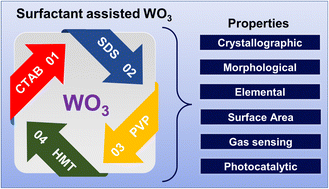
Surfactants play a pivotal role in the kinetics of nucleation and accretion of nanoparticles in such a way that they serve as a template for the development of nanostructures, consequently influencing the morphology, dimensions, and other surface properties. Herein, we report the influence of cationic and anionic surfactants (CTAB, SDS, PVP and HMT) on the development of pristine WO3 nanostructures and their impact on gas sensing and photocatalytic properties of WO3. The various surfactant-assisted WO3 nanostructures were synthesized via a straightforward hydrothermal route and systematically analyzed using XRD, FESEM-EDAX, TEM/HRTEM, XPS, UV-Vis, and BET measurements. Gas sensing properties of various oxidizing and reducing gases revealed superior selectivity towards acetone. Among the various surfactant-assisted WO3, CTAB/WO3 exhibited an excellent response of 84.84% towards 100 ppm acetone at an optimal operating temperature of 300 °C. The CTAB/WO3 sensor exhibited a linear response to acetone at lower concentrations, showing a 4.8% response at 0.8 ppm, which delineates the threshold between healthy and diabetic breath acetone levels. At 1.8 ppm, the sensor recorded 8.1% response, aligning with diabetes values reported by National Institute for Occupational Safety and Health (NIOSH). Moreover, photocatalytic performance evaluations demonstrated a methylene blue degradation efficiency of 47.19% under natural solar irradiation. This work will motivate researchers in developing high performance acetone gas sensors and photocatalytic dye-degradation by the integration of appropriate surfactants in WO3 nanostructures.
 Please wait while we load your content...


