Issue 19, 2025, Issue in Progress

Purity improvement and efficient recovery of levoglucosan mist produced by fast pyrolysis of cellulose using corona discharge

Abstract

Cellulose can be efficiently decomposed through fast pyrolysis. However, the mist products generated during this process are difficult to collect efficiently because they remain suspended in the gas phase for an extended period (20–30 min). In this study, we attempted to overcome this problem by using corona discharge treatment to add static electricity, which allowed us to collect the mist products more effectively. This method facilitated the rapid agglomeration of mist products, primarily composed of levoglucosan (LG), allowing for their easy recovery as condensate. Conversely, the aldehydes produced as by-products of the pyrolysis process remained in the gas phase and were unaffected by the static electricity. Consequently, the application of corona discharge improved the purity of LG compared to the untreated process, providing valuable insights into the production of fermentable sugar solutions via subsequent mild hydrolysis. These results demonstrate the feasibility of simultaneously recovering and refining products using static electricity.
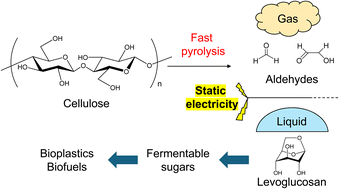
Graphical abstract: Purity improvement and efficient recovery of levoglucosan mist produced by fast pyrolysis of cellulose using corona discharge

Supplementary files

Transparent peer review

To support increased transparency, we offer authors the option to publish the peer review history alongside their article.

View this article’s peer review history

Article information

Article type
Paper
Submitted
07 Mar 2025
Accepted
29 Apr 2025
First published
08 May 2025
This article is Open Access
Creative Commons BY-NC license

RSC Adv., 2025,15, 14876-14880

Purity improvement and efficient recovery of levoglucosan mist produced by fast pyrolysis of cellulose using corona discharge

T. Nomura, E. Minami and H. Kawamoto, RSC Adv., 2025, 15, 14876 DOI: 10.1039/D5RA01634G

This article is licensed under a Creative Commons Attribution-NonCommercial 3.0 Unported Licence. You can use material from this article in other publications, without requesting further permission from the RSC, provided that the correct acknowledgement is given and it is not used for commercial purposes.

To request permission to reproduce material from this article in a commercial publication, please go to the Copyright Clearance Center request page.

If you are an author contributing to an RSC publication, you do not need to request permission provided correct acknowledgement is given.

If you are the author of this article, you do not need to request permission to reproduce figures and diagrams provided correct acknowledgement is given. If you want to reproduce the whole article in a third-party commercial publication (excluding your thesis/dissertation for which permission is not required) please go to the Copyright Clearance Center request page.

Read more about how to correctly acknowledge RSC content.

Social activity

Spotlight

Advertisements