


 PLATFORM UPDATE:


Cluster model study of the mechanism and origins of enantio- and chemoselectivity in non-heme iron enzyme-catalyzed C–H azidation†
 a
and
Yun-Fang
Yang
*a
a
and
Yun-Fang
Yang
*a
Abstract
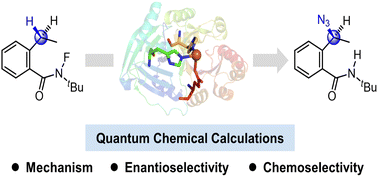
The mechanisms and enantio- and chemoselectivities of non-heme iron enzyme-catalyzed C–H azidation were investigated using density functional theory (DFT) calculations. A detailed active site cluster model comprising 337 atoms was constructed, incorporating essential features of the first- and second-coordination spheres and substrate-binding pockets. The catalytic cycle involves N–F bond activation, hydrogen atom transfer (HAT), and radical rebound steps. DFT calculations suggest that the observed enantioselectivity arises from steric effects between the substrate and key active-site residues. Additionally, in the non-heme Fe(N3)F complex, the Fe–N3 bond, which has a lower diabatic bond dissociation energy, preferentially rebounds to form the azidation product.
- This article is part of the themed collection: 2025 RSC Advances Popular Advances Collection
 Please wait while we load your content...


