


 PLATFORM UPDATE:


Unraveling steric and dispersion effects in gold catalysis: a DFT study of asymmetric cyclization/Mannich reactions

Abstract
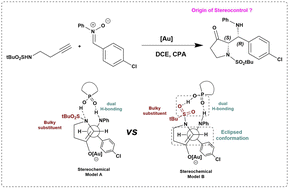
The cooperative catalysis between gold complexes and chiral phosphoric acids (CPA) enables asymmetric oxidative cyclization/Mannich reactions of homopropargyl amides, providing efficient access to chiral spiroindolenines with high enantioselectivity. However, the mechanistic details, particularly the origin of stereocontrol governed by the interplay of steric and dispersion effects, remain elusive. Herein, we present a comprehensive density functional theory (DFT) study to unravel the reaction mechanism and the decisive factors controlling enantioselectivity. Our computations reveal that the catalytic cycle proceeds through gold–carbene formation, regioselective N–H insertion, enolization, and the stereodetermining Mannich addition. The enantioselectivity is primarily dictated by the Mannich step, wherein the favored transition state (TS-SR) is stabilized by a synergistic network of noncovalent interactions, including hydrogen bonding and dispersion forces between the sulfonamide group and the CPA catalyst. Quantitative distortion–interaction analysis demonstrates that dispersion interactions contribute significantly (∼3.0 kcal mol−1) to the energy difference between diastereomeric transition states. This study not only clarifies the stereochemical model but also provides a rational basis for future catalyst design in gold/CPA cooperative catalysis.
 Please wait while we load your content...


